Chalkboards and Broken Promises: Why North Carolina Is Losing Its Most Dedicated Educators — and What Kelly Will Do to Stop It
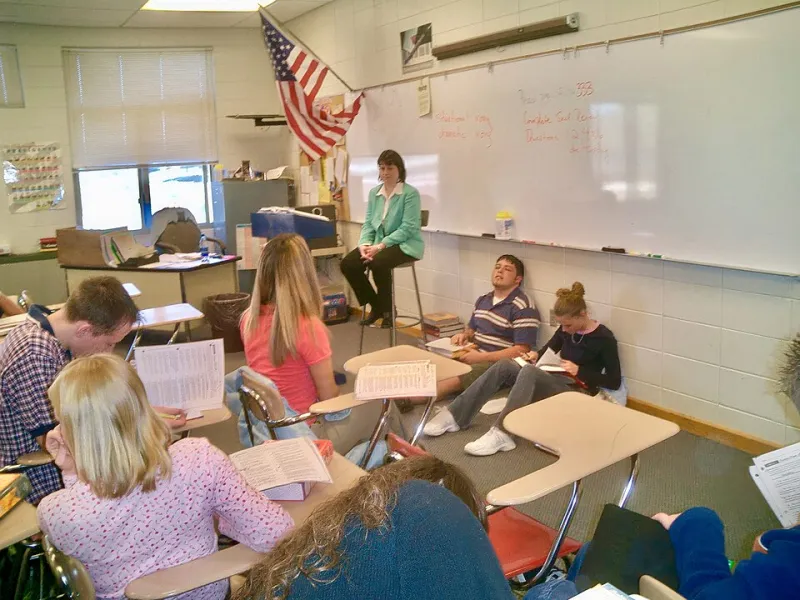
Photo: Harrison Keely, CC BY 4.0, via Wikimedia Commons
When Maria Delgado walked out of her fifth-grade classroom in Robeson County for the last time, she did not cry. After eleven years of teaching, she had already spent her tears. She had purchased her own supplies, worked second jobs during summers to make ends meet, and watched colleagues disappear one by one — lured away by better salaries in Virginia, South Carolina, or simply out of the profession altogether.
"I loved those kids more than anything," she said in a conversation with Kelly's campaign team during a listening tour through southeastern North Carolina. "But love doesn't pay rent. And the state made it clear, year after year, that it didn't value what I was doing."
Maria's story is not an outlier. It is a pattern — and it is threatening to undermine the educational foundation that North Carolina's future depends upon.
The Numbers Tell a Troubling Story
North Carolina has ranked near the bottom of national teacher salary rankings for more than a decade. According to the National Education Association, the state's average teacher salary trails the national average by several thousand dollars annually, placing it well behind neighboring Virginia, which has made aggressive investments in educator compensation in recent years.
But salary is only part of the picture. The North Carolina Department of Public Instruction has reported thousands of teaching vacancies across the state in recent years, with rural districts bearing the heaviest burden. In counties like Bertie, Anson, and Scotland, the shortage is so severe that students are routinely placed with long-term substitutes in core subjects — a situation that would be considered a crisis in any other context.
Attrition rates compound the problem. Surveys conducted by the North Carolina Association of Educators consistently show that a significant proportion of teachers are considering leaving the profession within the next five years, citing inadequate pay, administrative burden, and a deteriorating sense of professional respect as primary reasons.
What Teachers Are Actually Saying
Kelly's campaign has made a point of going directly to educators rather than relying solely on policy documents. The conversations have been illuminating.
In Guilford County, a high school science teacher named David Okafor described spending nearly three thousand dollars of his own money on classroom materials last year — a figure that represents a meaningful portion of his take-home pay after taxes and benefits. "I have a master's degree and fifteen years of experience," he said. "My neighbor who drives a delivery truck earns more than I do. At some point, you have to ask yourself hard questions."
In Buncombe County, a veteran reading specialist named Terri Lawson described the emotional toll that has become inseparable from the job. "The paperwork has tripled. The behavioral challenges have intensified. And the administrative support has shrunk. Teachers are burning out not because they don't care — but because they care so much and feel so unsupported."
These testimonies reflect a workforce under siege — not from a lack of dedication, but from a systemic failure of investment and respect.
How North Carolina Compares to Its Neighbors
The regional context is particularly damning. Virginia recently enacted legislation to push its average teacher salary above the national average, a deliberate strategy to attract and retain talent. Tennessee has invested heavily in mentorship programs and career ladder initiatives that give teachers a pathway for professional growth without leaving the classroom. Georgia has piloted loan forgiveness programs targeting educators who commit to underserved districts.
North Carolina, by contrast, has watched its teacher pipeline shrink. University enrollment in education programs has declined substantially over the past decade, a signal that young people are making rational economic decisions to pursue other fields. The state is not merely failing to recruit teachers — it is actively discouraging the next generation from entering the profession.
Kelly's Plan: Respect, Compensation, and Real Support
Kelly's approach to the teacher shortage is grounded in a fundamental conviction: that the educators shaping North Carolina's children deserve to be treated as the professionals they are. The plan rests on three interconnected pillars.
Competitive, Livable Wages. Kelly is committed to raising North Carolina's average teacher salary to at least the national average within a defined legislative timeline, with additional pay enhancements for educators working in high-need districts and shortage subject areas such as special education, mathematics, and science. This is not a symbolic gesture — it is a fiscal commitment backed by a detailed funding strategy that includes closing corporate tax loopholes that have deprived the state of revenue for over a decade.
Reducing Administrative Burden. Kelly supports legislation that would audit and streamline the reporting requirements currently placed on classroom teachers, returning meaningful portions of the school day to actual instruction. Teachers should spend their time teaching — not filling out redundant forms or navigating bureaucratic systems that drain their energy and enthusiasm.
Meaningful Professional Development and Career Pathways. Kelly's plan includes the creation of a state-funded career ladder program that allows experienced teachers to take on mentorship and instructional leadership roles with corresponding pay increases — without being forced to move into administration. Staying in the classroom should not mean stagnating professionally or financially. Additionally, Kelly supports expanded loan forgiveness programs for educators who commit to serving in underserved communities for a minimum of four years.
Why This Is an Economic Justice Issue
The teacher shortage is not merely an education policy challenge — it is fundamentally a question of economic fairness. When rural and low-income communities cannot attract or retain qualified teachers, the children in those communities face diminished opportunities. Those diminished opportunities translate into lower lifetime earnings, reduced civic participation, and a cycle of economic disadvantage that is extraordinarily difficult to break.
Conversely, when teachers are paid well and supported properly, they spend that money in local economies, they stay in their communities, and they serve as anchors of civic stability. Investing in teachers is investing in the economic vitality of every county in North Carolina — from Cherokee to Dare.
A Promise to North Carolina's Educators
Kelly has been unequivocal on this issue throughout the campaign: the status quo is not acceptable, and incremental half-measures will not solve a crisis of this magnitude. North Carolina's teachers have given generously to this state for generations, often at personal financial sacrifice. It is long past time for that generosity to be honored with genuine, sustained investment.
Maria Delgado now works in a different field. She misses her students every day. Kelly's hope — and commitment — is that the next generation of educators like Maria will never have to make the choice she did.